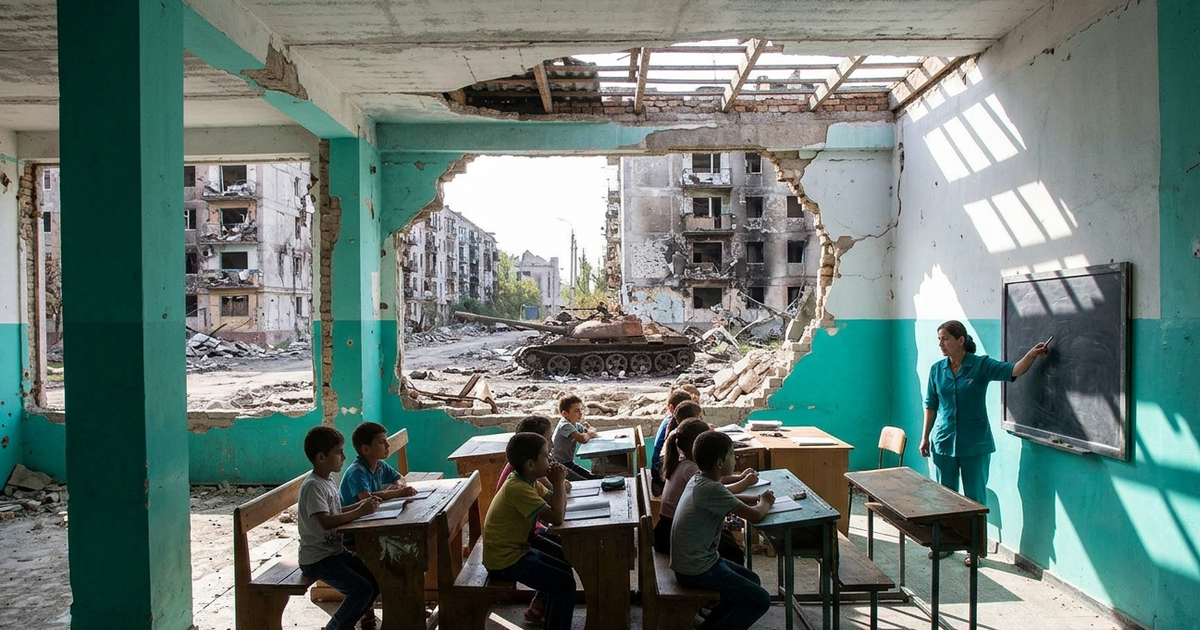
Armed conflicts inflict profound and lasting damage well beyond the immediate physical destruction of infrastructure and loss of life. One of the most enduring consequences of war is its effect on human capital, which includes the collective skills, education, health, and productive capacity of a population. These impacts, in turn, affect long-term economic productivity. Research across multiple conflict contexts shows that war interrupts the development of people and skills in ways that can hinder economic performance for decades.
Disruption of Education and Learning
One of the most direct impacts of war is the disruption of education systems. When schools are closed, destroyed, or unsafe to attend, children experience losses in learning time, declines in educational attainment, and worse learning outcomes. Studies of past conflicts indicate that exposure to armed conflict can reduce student test scores significantly, sometimes by up to a full standard deviation in core subjects like mathematics and reading when compared with unaffected peers. These learning setbacks stem from damaged infrastructure, teacher displacement, household income decline, and the psychological toll of conflict on young learners.
Such disruptions yield a long-term reduction in human capital because young generations enter adulthood with weaker foundational knowledge and skills, which undermines future labor productivity.
Losses in Adult Skills and Workforce Capacity
Conflicts also diminish the quality and availability of adult skills. Wars lead to forced migration, prolonged unemployment, and deterioration of work experience, all of which weaken the labor force. Prolonged periods without stable employment are associated with erosion of skills and knowledge, while displacement and forced migration can fragment career paths and disrupt professional development. In some cases, workers who remain may find their skills outdated or less relevant to post-conflict economic needs.
Moreover, the forced movement of skilled individuals, sometimes seeking safety abroad, can change the composition of the workforce and reduce the proportion of highly educated and experienced workers in the affected region.
Economic and Productivity Consequences
The cumulative effect of education disruption and skill losses is a measurable decline in broader economic productivity. Historical analyses of armed conflicts show that wars tend to shrink economic output, reduce investment in physical and human capital, and depress per-capita income. For example, a major study of 135 wars since World War II found that, on average, armed conflict is associated with a decline in real GDP by around 13 percent, alongside reductions in investment, consumption, exports, and overall economic activity that can persist for years after hostilities end.
The connection between human capital and productivity is well-established in economics. A workforce with lower aggregate skills and weaker educational outcomes is less able to adopt new technologies, innovate, or absorb productive advances. As a result, total factor productivity, which measures the efficiency of labor and capital, tends to fall in war-affected regions.
Long-Term and Intergenerational Effects
The adverse impacts of armed conflict are not confined to the wartime period. Educational and skill losses experienced by children and adults can carry over for decades, affecting lifetime earnings, career trajectories, and economic competitiveness. Even after active conflict ends, rebuilding human capital requires sustained policy action and investment in education, training, health, and job-placement programs.
In some cases, displaced or returning populations bring new skills, language competencies, or networks gained abroad, which can partially offset losses. Yet, without targeted support for education and workforce development, these gains may be limited.
Conclusion
Wars inflict deep and enduring damage on human capital through disrupted education, skill erosion, and labor force dislocation. These losses translate into lower productivity and slower economic recovery long after active fighting ceases. Understanding these human capital dynamics is crucial for effective post-conflict reconstruction and for policies that aim to restore both economic performance and human development.