In the current landscape of rapid AI integration, a common misconception has taken root: that technical skills are the only currency that matters. However, the latest research from Deloitte’s 2026 Global Human Capital Trends suggests the opposite.
We are entering an era of Humans x Machines, where the most valuable asset isn’t just the technology itself but the "Power Skills" that multiply its impact.
The "Knowing-Doing" Gap
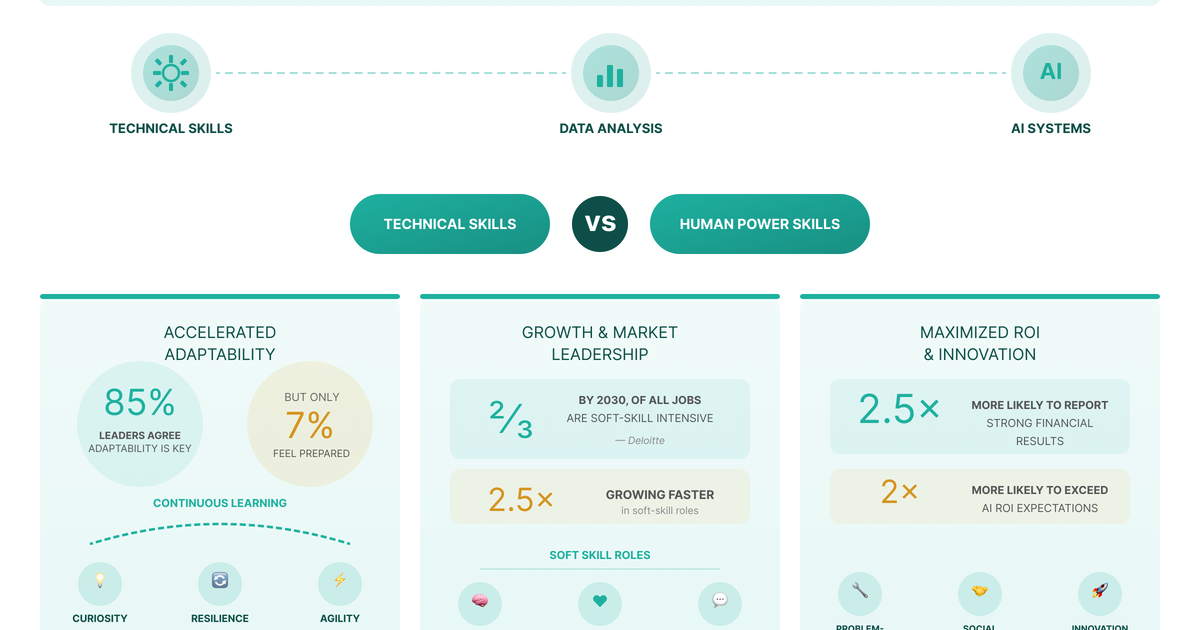
While 85% of business leaders acknowledge that organizational adaptability is now a critical competitive advantage, only 7% feel they are successfully helping their workforce grow and adapt at the necessary speed.
This "knowing-doing" gap is where the modern professional—and the modern organization— either thrives or falters. Deloitte’s findings highlight a shift from episodic change to "changefulness": the ability to embed continuous learning and agility directly into the flow of work.
Power Skills by the Numbers
The shift isn't just a feeling; it’s a measurable economic trend. According to Deloitte Access Economics, the demand for human-centric capabilities is reshaping the global labor market:
- 2030 Outlook: Soft-skill intensive occupations are forecast to account for two-thirds of all jobs by 2030.
- Growth Velocity: These roles are growing at 2.5 times the rate of other occupations.
- The Graduate Standard: Employers now expect 93% of new graduates to possess high-level problem-solving and interpersonal skills from day one.
Beyond Automation: The Redesign of Work
The research makes it clear: technical skills have a shrinking "half-life." What was cutting-edge three years ago is often obsolete today. In contrast, Power Skills—such as emotional intelligence, resilience, and curiosity—are "enduring capabilities."
Organizations that intentionally design work around human-AI collaboration see a massive return on investment. Those focusing on the "human edge" are:
- 2.5x more likely to report strong financial results.
- 2x more likely to exceed their AI ROI expectations.
The Scofolio Perspective
Technical proficiency is the foundation, but Power Skills are the architect. In a world where one-third of workers experienced over 15 major organizational changes last year alone, the ability to think, lead, and connect isn't just a "nice-to-have."
It moves beyond mere inquisitiveness to a structured approach that pauses to examine causes, challenges the status quo, and builds trust through empathetic, open-ended questioning. It is the fundamental skill set that ensures we don't just survive the age of AI, but lead it.
Frequently Asked Questions
What exactly are "Power Skills"?
Power skills are the interpersonal and cognitive capabilities—such as conflict literacy, adaptability, and emotional intelligence—that allow individuals to apply technical knowledge effectively in complex, human environments.
Why is the "half-life" of technical skills shrinking?
As AI and automation evolve, the specific tools and languages used to execute tasks change rapidly. A technical skill that is essential today may be automated or replaced by a new framework within a few years, whereas power skills remain relevant regardless of the technology used.
How does "changefulness" differ from traditional change management?
Traditional change management treats change as an "episode" with a beginning and an end. "Changefulness" is the ability to stay in a constant state of evolution, treating agility and learning as a permanent part of the daily workflow.